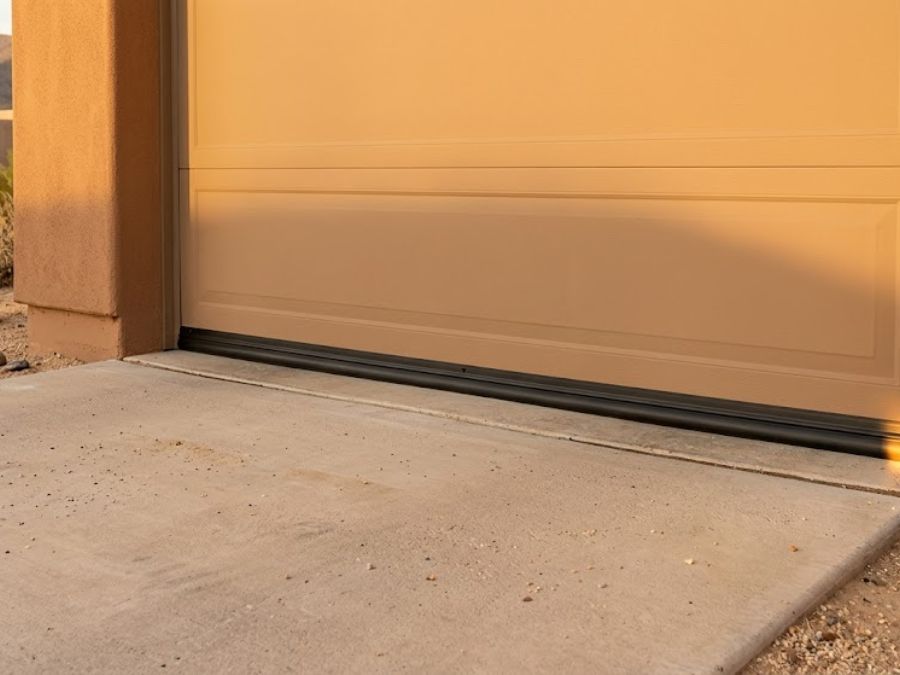
How Do I Stop Scorpions and Pests From Getting Under My Garage Door in Phoenix?
Quick Answer:
To stop scorpions and pests from entering your Phoenix garage, you need to eliminate what we call the “light gap.” That requires three things working together:
- Material: Replace standard vinyl seals with heat-resistant EPDM rubber or silicone-based seals
- Alignment: Make sure the door is square so both corners seal at the same time
- Threshold: If the concrete is uneven, install a permanent rubber threshold to close low spots
If you can see daylight under your garage door during the day, a scorpion can get in at night.
Why Garage Doors Are a Major Entry Point in Phoenix
In Phoenix, your garage door is one of the most common and most overlooked entry points for pests, especially scorpions.
When we’re out on service calls across the Valley, we consistently find small gaps along the bottom of garage doors that homeowners didn’t realize were there. These gaps are easy to miss because the door looks closed from a distance, but when you get down to ground level, you can usually see where the seal has lost contact.
The reality is that it does not take much. A Bark Scorpion only needs a gap about the thickness of a credit card to get inside, and once that opening exists, it becomes a reliable entry point.
Garages also create the kind of environment pests are actively looking for. They provide shade during the day, retain warmth at night, and offer protection from the elements. In many cases, they also contain storage, clutter, or moisture that gives pests places to hide. Once pests get into the garage, it becomes significantly easier for them to move into the home itself.
What Actually Causes Gaps Under Garage Doors
Most pest problems start with how the door meets the ground, and in Phoenix, the pattern is very consistent.
The bottom seal breaks down from heat and loses flexibility, so it stops conforming to the concrete. At the same time, many garage slabs are not perfectly level, especially in older homes or alley-loaded garages, which creates low spots where gaps naturally form. On top of that, doors naturally shift over time from daily use, causing one corner to sit tighter than the other.
What makes this tricky is that these problems often overlap. A homeowner might replace a seal expecting a full fix, but the gap remains because the floor is uneven. Or the door may be adjusted, but the seal itself has already hardened and can no longer compress.
Until all three factors are addressed together—seal condition, floor condition, and alignment—the problem tends to persist.
Why Standard Seals Fail So Quickly in Phoenix
Phoenix is one of the toughest environments in the country for garage door materials, and bottom seals are usually the first thing to fail.
Most builder-grade doors come with vinyl seals because they are inexpensive and easy to install. The problem is that in Phoenix’s heat, vinyl does not hold up over time. After a couple of summers, it dries out, loses flexibility, and becomes brittle enough to crack or break apart.
We’ve seen plenty of situations where the seal still looks intact at a glance, but it has hardened to the point where it no longer compresses against the concrete. At that stage, it is not sealing anything, even though it appears to be in place.
This is why upgrading materials matters. EPDM rubber and silicone-based seals are designed to maintain flexibility in higher temperatures, which allows them to keep consistent contact with the floor even during extreme heat cycles.
The “Heat-Sink” Problem Most Homeowners Miss
One of the biggest reasons quick fixes fail in Phoenix has nothing to do with the seal itself. It is the surface it is sitting on.
Garage floors and door headers can reach extremely high surface temperatures during the summer, especially on south and west-facing homes that get prolonged sun exposure. That heat does not just stay in the air. It transfers directly into the concrete and into anything touching it.
We often see adhesive-based products fail because of this. A peel-and-stick seal might seem secure at first, but after repeated heat cycles, the adhesive softens, shifts, or completely loses its bond with the surface.
This is why so many temporary fixes only last a short time. It is not just UV exposure breaking them down. It is the direct contact heat from the garage floor that causes materials to deform or fail entirely.
What Actually Stops Scorpions and Pests
Stopping pests is not about adding more material. It is about eliminating every gap along the bottom edge of the door and making sure the system works as a whole.
When we address this at home, we look closely at how the door behaves when it closes. The seal needs to make consistent contact across the entire opening, not just in the center. Both corners need to meet the floor at the same time, and the door has to come down cleanly without shifting or catching.
Even a small inconsistency can create a gap. And in Phoenix, those gaps are not occasional vulnerabilities. They become dependable entry points that pests will continue to use.
The Bark Scorpion Challenge
Scorpions are different from most pests you deal with around the garage, and that changes how you have to approach sealing.
A Bark Scorpion can climb vertical surfaces and squeeze through extremely tight spaces, which is why small gaps that might not matter for other pests become a serious issue here. Standard flap-style seals tend to fold or curl over time, especially at the corners, creating a small tunnel effect that scorpions can use.
We typically recommend J-type or bulb-style seals in these situations because they create a more consistent, pressurized seal against the floor. Instead of just covering the gap, they actively compress into it, leaving little to no clearance.
That difference in seal design is often what determines whether pests get through or not.
The Role of Uneven Concrete
Uneven concrete is one of the biggest reasons pest problems keep coming back, especially in older Phoenix neighborhoods.
We regularly see garage floors with slight dips, slopes, or worn areas that create gaps under the door. In neighborhoods with older construction, this is not unusual. Over time, the slab settles, and those small changes in elevation start to affect how the door seals.
In these cases, replacing the seal alone will not solve the issue. The seal can only do so much if the surface beneath it is inconsistent.
This is where oversized seals or threshold barriers come into play. A larger seal can bridge deeper gaps, while a threshold creates a new, consistent surface for the door to close against. Without addressing the floor itself, the gap will continue to reappear.
Why Door Alignment Matters More Than Most People Realize
A garage door has to close evenly across the entire opening to seal properly, and even a small misalignment can leave a gap.
Over time, tracks can shift slightly, hardware can loosen, and the structure itself can settle. These changes are gradual, so they are easy to overlook, but they directly affect how the door sits when it closes.
This is why pest activity often shows up on one side of the garage rather than the other. The door may appear closed, but one corner is not making full contact with the floor.
That small difference is enough to create a consistent entry point.
The Problem With Quick Fixes
We get a lot of calls after homeowners try to fix this with quick solutions, and in Phoenix, those almost always fail.
Foam strips, adhesive seals, and temporary barriers might seem like a simple fix, but they are not designed for the kind of heat and surface conditions found here. In many cases, they break down within a single summer or shift out of place after repeated use.
The bigger issue is that these fixes address the symptom, not the cause. If the door is misaligned or the concrete is uneven, adding material on top does not solve the problem. It only delays it and often makes the underlying issue harder to identify later.
When a Threshold Seal Makes Sense
There are situations where a threshold seal is the right solution, especially when the garage floor is uneven or sits slightly above the surrounding grade.
A threshold creates a raised surface for the door to close against, helping to eliminate gaps that a bottom seal alone cannot fully cover. It also provides an added layer of protection against water intrusion during monsoon storms.
When used alongside a properly aligned door and a durable bottom seal, it can significantly improve both pest resistance and overall sealing performance.
Don’t Overlook the Sides and Corners
The bottom of the door gets most of the attention, but the sides and corners are just as important.
We often find weatherstripping along the frame that has dried out, cracked, or pulled away from the surface over time. These gaps are easy to miss because they are not as visible as a gap along the bottom.
However, they can still allow smaller pests to enter. Fixing the bottom seal alone will not fully solve the problem if the sides are compromised.
How to Tell If Your Garage Door Is Letting Pests In
The simplest way to check your garage door is to look at it when it is fully closed and focus on the edges.
If you can see light coming through anywhere along the bottom or corners, that is a clear indication of a gap. You may also notice dust or debris collecting just inside the door, which suggests outside air is getting in.
In many cases, repeated pest activity inside the garage is the most obvious sign. If pests are showing up regularly, the door is not sealing the way it should.
Making Your Garage Less Attractive to Pests
Sealing the door is the most important step, but it also helps to reduce what attracts pests in the first place.
Garages that tend to have more activity often share a few conditions:
- Clutter that creates hiding spots
- Food or trash left exposed
- Moisture from leaks or poor drainage
Reducing these factors makes the space less appealing and less likely to hold pests, even if a small gap exists.
What a Proper Seal Should Look Like
When a garage door is sealing correctly, it should sit evenly across the entire opening with consistent pressure along the bottom.
There should be no visible light, no gaps at the corners, and the door should close smoothly without resistance. The seal should compress slightly against the floor without flattening out completely.
If any part of that is missing, there is still an entry point.
Getting Ahead of the Problem
In Phoenix, garage door seals are not a one-time fix. They are part of regular maintenance.
Checking the seal periodically, watching for early signs of wear, and addressing small gaps before they grow larger can prevent bigger issues down the line.
Why This Matters More in Phoenix
Scorpions and desert pests are part of life in the Phoenix Valley, but regular indoor encounters are not something you have to accept.
The garage door is one of the largest openings in the home and one of the most common failure points when it comes to sealing. When it is properly aligned and sealed with the right materials, it removes one of the most reliable access points pests depend on.
Getting that right makes a noticeable difference, especially during peak heat when pest activity is at its highest.