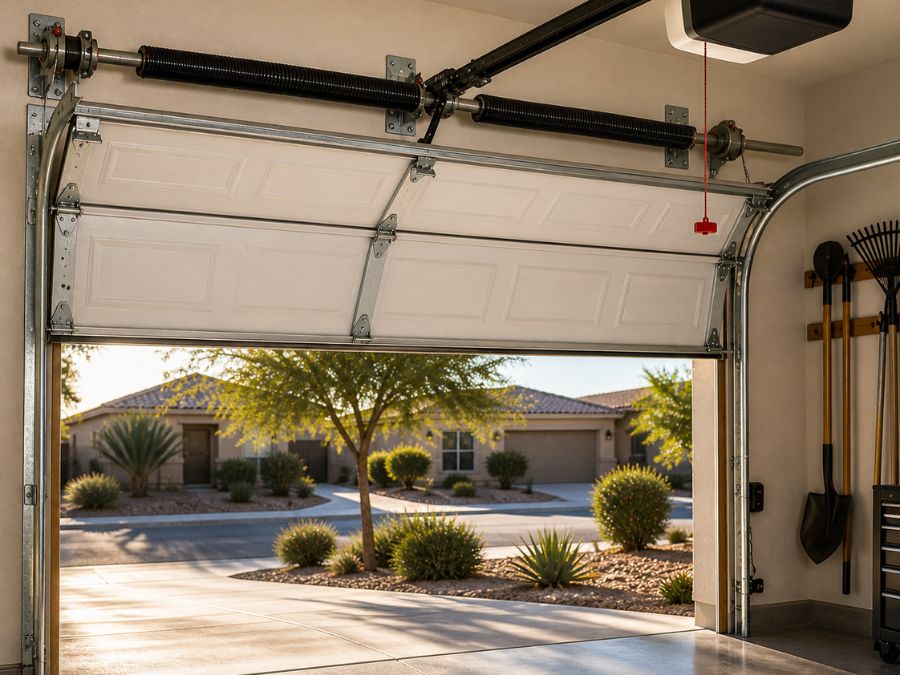
Why Does My Garage Door Reverse By Itself Every Afternoon In Arizona?
If your garage door reverses by itself every afternoon in Arizona, the most common cause is heat affecting the safety sensors or the opener’s sensitivity settings. Extreme temperatures can interfere with alignment, wiring, or internal components. In most cases, it’s not a major failure—just a system reacting to environmental conditions.
Why This Happens at the Same Time Every Day
When a problem shows up at the same time every afternoon, that’s usually a clue. In Arizona, afternoon heat is when temperatures peak and conditions are most extreme. Garages can reach well over 120°F during that window.
That heat changes how components behave. Materials expand slightly, electronics get stressed, and sunlight becomes more intense. All of that can affect how your garage door system responds.
So it’s not random—it’s tied directly to temperature and sun exposure. The timing is what helps narrow down the cause.
The Most Common Cause: Sensor Interference from Sunlight
Garage doors rely on safety sensors near the bottom of the tracks. These sensors send an invisible beam across the opening, and if that beam is interrupted, the door reverses. It’s a built-in safety feature.
In Arizona afternoons, direct sunlight can hit those sensors at the right angle and interfere with the beam. The system interprets that as an obstruction, even when nothing is there. That’s why the door starts closing and then immediately reverses.
This is one of the most common issues I see during summer. It usually shows up on doors that face west or get strong afternoon sun.
How Heat Affects Sensor Alignment
Heat doesn’t just affect light—it also affects physical alignment. As temperatures rise, metal tracks and brackets expand slightly. That small shift can move the sensors just enough to break the beam connection.
When the sensors are even slightly misaligned, the opener sees it as a blockage. The result is the door reversing or refusing to close properly. This tends to happen more in the afternoon when expansion is at its peak.
Once temperatures drop in the evening, everything contracts again. That’s why the problem often “disappears” later in the day.
Dust and Debris Make It Worse
Arizona dust plays a role in this problem as well. Fine particles settle on the sensor lenses and reduce their ability to send and receive a clean signal. When combined with bright sunlight, it increases the chances of interference.
Dirty lenses can make the system more sensitive to disruption. What might normally be a minor issue becomes enough to trigger a reversal. This is especially common after dust storms or windy days.
Cleaning the sensors is a simple step, but it often gets overlooked. In this climate, it makes a noticeable difference.
Opener Sensitivity Settings Can Be a Factor
Garage door openers have force and sensitivity settings built in. These control how much resistance the system tolerates before reversing. In extreme heat, components may create slightly more friction, which can trigger the safety system.
If the opener is set too sensitive, it may interpret normal movement as resistance. That can cause the door to reverse even when nothing is in the way. This is more noticeable during the hottest part of the day.
Adjusting these settings can help, but it needs to be done carefully. Too much adjustment can create safety risks.
Wiring and Heat Expansion Issues
Wiring inside the garage door system can also be affected by heat. Insulation around wires can degrade over time in Arizona conditions. As wires expand and contract, connections may become inconsistent.
This can cause intermittent signals between the sensors and the opener. The system may behave unpredictably as a result. In some cases, this leads to random reversing.
These issues are harder to spot because they aren’t always visible. They tend to show up only under certain conditions, like peak heat.
Why It’s Usually Not a Major Failure
The good news is that this problem is rarely a sign of a major mechanical issue. Most of the time, it’s related to environment, alignment, or minor adjustments. That’s why it tends to come and go rather than stay constant.
If the door works fine in the morning and evening, the system itself is likely still in good condition. The problem is how it reacts under stress. That makes it easier to fix compared to full system failures.
Still, it shouldn’t be ignored. Small issues can lead to larger ones over time if left unaddressed.
What You Should Check First
Start by looking at the safety sensors. Make sure they are clean, aligned, and not directly exposed to sunlight. Even a small adjustment or shade can make a big difference.
Next, check for any visible dust buildup or debris around the tracks. Cleaning these areas helps reduce interference and friction. It’s a quick step that often improves performance right away.
If the issue continues, consider whether the opener settings or wiring may be involved. At that point, a closer inspection may be needed.
When It’s Time to Take a Closer Look
If your garage door reverses consistently every afternoon, it’s worth addressing sooner rather than later. Repeated reversing can put extra strain on the opener and other components. Over time, that leads to wear.
It’s also a safety concern. A door that doesn’t close properly leaves your garage exposed. That’s something most homeowners want to avoid.
In Arizona, heat-related issues tend to repeat daily during summer. Fixing the root cause helps prevent ongoing frustration.
What This Means for Arizona Homeowners
If your garage door reverses every afternoon, it’s usually reacting to heat, sunlight, or minor alignment issues. These are common in Arizona and often easy to correct once identified. The key is understanding how the environment affects the system.
A few small adjustments—cleaning sensors, improving alignment, or reducing sun exposure—can solve the problem in many cases. You don’t always need major repairs to fix it.
In this climate, your garage door isn’t just dealing with use—it’s dealing with extreme conditions every day. Once you account for that, these issues start to make a lot more sense.