Can The Sun Near The McDowell Mountains Cause My Garage Door Sensor To Malfunction?
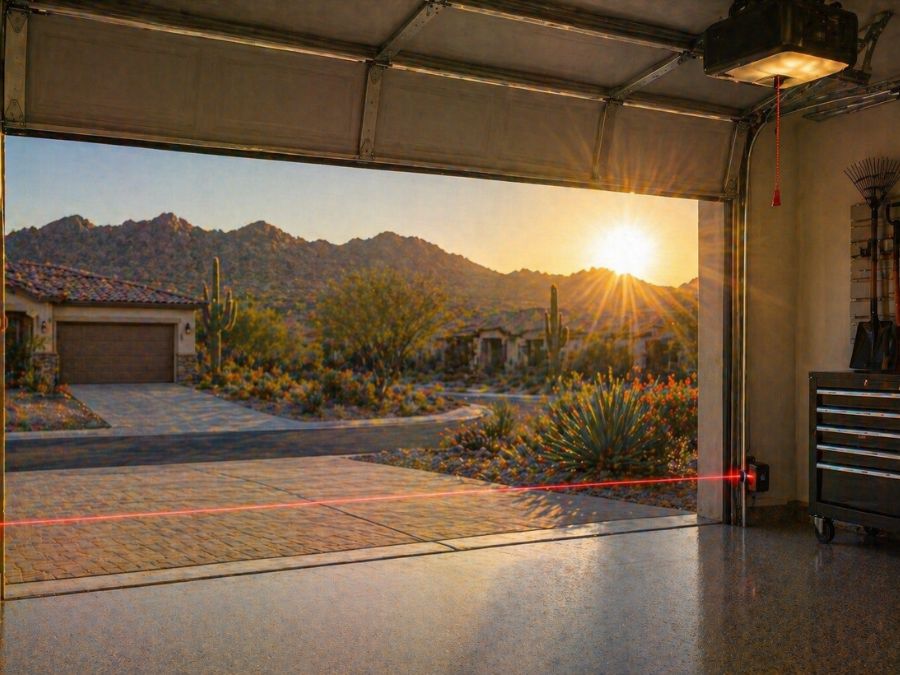
Yes, in Scottsdale especially near the McDowell Mountains, direct sunlight can interfere with garage door safety sensors. Intense glare can disrupt the sensor beam, making the system think something is blocking the door. When that happens, the door may refuse to close or behave inconsistently.
This Is More Common in Scottsdale Than People Think
This is one of those issues that catches homeowners off guard. Everything works fine in the morning, then later in the day the door suddenly won’t close or starts reversing for no clear reason. By the evening, it’s back to normal.
In areas near the McDowell Mountains, the sun angle can be especially intense depending on your home’s orientation. That low, direct light in the late afternoon can hit your garage opening at just the right angle to interfere with the sensors. It’s not a defect, it’s a condition the system wasn’t designed to handle perfectly.
I’ve seen this happen in newer homes just as often as older ones. The system itself is working as intended, but the environment is creating a false signal.
How Garage Door Sensors Actually Work
Garage door safety sensors are simple in concept but sensitive in operation. One side sends an invisible beam across the bottom of the door opening, and the other side receives it. If that beam is interrupted, the system stops the door from closing.
That’s what prevents the door from coming down on a person, pet, or object. It’s a critical safety feature and required on all modern garage door systems. The problem is, the sensors don’t always know the difference between a real obstruction and interference.
Strong sunlight can overwhelm the receiving sensor. When that happens, the system interprets it as a blocked beam, even though nothing is actually in the way.
Why the McDowell Area Makes It Worse
Scottsdale already gets intense sun, but the positioning near the McDowell Mountains can make the effect more noticeable. Depending on how your home is situated, the sun can hit your garage opening at a direct, low angle during certain times of day.
That angle matters. When sunlight comes in straight across the sensor line, it can flood the receiver with light and disrupt the signal. It’s not constant, it usually happens during a specific window of time, which is why the issue seems inconsistent.
Homes with west-facing garages are especially prone to this. Late afternoon sun tends to be the strongest and most disruptive, particularly during summer months when brightness and heat peak.
What the Problem Looks Like in Real Life
Most homeowners notice this when the garage door refuses to close. You hit the button, the door starts moving, then stops or reverses for no obvious reason. Sometimes you’ll see the opener lights flash, which is the system telling you there’s a sensor issue.
In other cases, the door won’t move at all unless you hold the wall button down continuously. That overrides the safety system temporarily, which is why it works but it’s not something you want to rely on long-term.
What makes this confusing is that everything looks fine. The sensors are aligned, nothing is blocking them, and the system worked earlier in the day. The only thing that’s changed is the position of the sun.
Why It Shouldn’t Be Ignored
Because the issue comes and goes, a lot of homeowners leave it alone. It feels like a minor inconvenience rather than a real problem. But inconsistent sensor behavior isn’t something to overlook.
If sunlight is interfering, there’s a chance the sensors are already close to being out of alignment or more sensitive than they should be. That can lead to more frequent issues over time, even when sunlight isn’t a factor.
There’s also the safety side to consider. These sensors are designed to prevent accidents. If they’re not working consistently, you don’t want to assume they’ll respond correctly in every situation.
What You Can Check First
If you’re dealing with this issue, start with a simple visual check. Make sure the sensors are clean and free of dust, which is common in Scottsdale. Even a light layer can affect performance when combined with direct sunlight.
Look at the alignment as well. Both sensors should be pointed directly at each other, with no tilt or shift. Even a small misalignment can make them more vulnerable to interference.
Pay attention to timing. If the issue only happens at a certain time of day, that’s a strong indicator that sunlight is involved. That pattern helps narrow things down quickly.
When It Makes Sense to Fix It Properly
If the problem keeps happening, it’s worth addressing it directly rather than working around it. There are a few ways to correct sunlight interference depending on the setup.
Sometimes it’s as simple as adjusting the angle of the sensors slightly so they’re not directly exposed to sunlight. In other cases, adding a small shield or repositioning the sensors can block glare without affecting performance.
This is one of those fixes that’s usually straightforward once you see what’s happening in person. The key is identifying the angle and exposure causing the issue, not just treating it like a generic sensor problem.
What I Tell Homeowners in This Situation
If your garage door acts up at the same time every day, there’s usually a reason. In Scottsdale, sunlight is often the missing piece, especially in areas near the McDowell Mountains where angles and exposure can be more intense.
The good news is this isn’t a major repair in most cases. It’s usually an adjustment, not a replacement. Once the sensors are set up to avoid direct interference, the problem tends to go away.
If you’re not sure what’s causing it, having someone take a look during the time of day it happens can make the answer obvious. It’s a simple issue once you see it but hard to guess without that context.