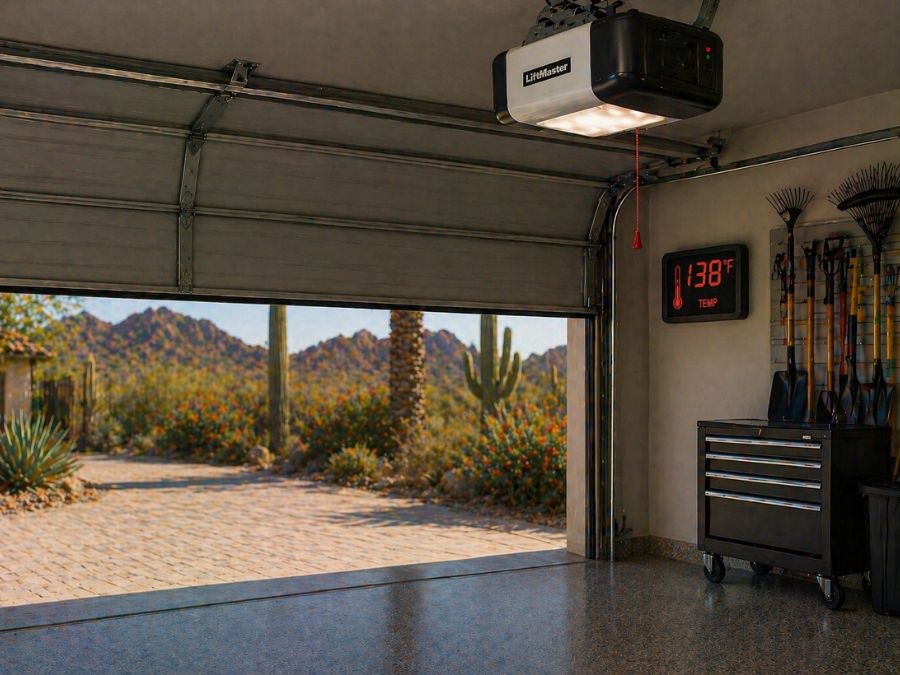
Why Your Garage Door Opener Stops Working in Phoenix Heat
If your garage door opener works in the morning but stops during the hottest part of the afternoon, the problem may involve heat inside the opener, direct sunlight affecting the safety sensors, or extra resistance from the garage door itself. If the door opens but will not close, start with the sensors. If the opener is completely silent, check power and the opener. If the door moves slowly, shakes, or struggles, the garage door may be making the opener work harder than it should.
Start With the Exact Symptom
How the system fails can help narrow down which part needs attention.
| What Happens | What It May Point To | Best First Check |
| Door opens but will not close | Safety sensor issue | Check sensor lights and direct sunlight |
| Opener is completely silent | Power or opener issue | Test the wall control and confirm power |
| Opener hums but the door barely moves | Extra resistance from the door | Watch for heavy or uneven movement |
| Door slows or jerks at the same point | Roller, track, spring, or balance issue | Note where the movement changes |
| System works again after cooling | Temperature may be contributing | Compare morning and afternoon operation |
The main distinction is whether the opener stops responding completely or the door still performs part of its normal cycle. A door that opens but will not close points toward a different problem than an opener that does not respond to the wall control at all.
Can Phoenix Heat Affect a Garage Door Opener?
High temperatures can affect garage door opener motors and electronic components, but heat should not automatically be blamed for every afternoon failure. Some openers use thermal protection that may temporarily interrupt operation if the motor becomes too hot.
The opener may also be struggling because the garage door is harder to move than it should be. Worn rollers, poor door balance, track resistance, or another mechanical issue can increase the load on the motor. Hot garage conditions may make an existing weakness easier to notice.
If the motor sounds strained or the door hesitates, shakes, or slows at the same point, the door system deserves attention along with the opener. If the unit stops completely and later begins working normally again, the motor or opener electronics may need closer inspection.
If the Door Opens but Will Not Close, Check the Safety Sensors
Safety sensors sit near the bottom of the garage door opening and need a clear signal between both sides. Dirt, misalignment, an obstruction, or strong direct light can interfere with normal closing operation.
Afternoon conditions can matter because sunlight reaches the garage opening at a different angle than it does earlier in the day. A west-facing garage may receive much stronger direct sun later in the afternoon.
Check the sensor indicator lights while the problem is happening. If one is blinking or off, clean both lenses, remove anything blocking the beam, and check whether direct sunlight is reaching one of the sensors. If the door closes normally earlier in the day but repeatedly refuses to close during the same period of direct light, the sensors should be checked before assuming the opener motor has failed.
The Garage Door May Be Creating Extra Strain
The opener is only one part of the lifting system. Garage door springs help counterbalance the weight of the door, while rollers, hinges, and tracks help it travel smoothly.
When those components are worn, damaged, or not moving correctly, the opener has to overcome more resistance. Warning signs include shaking, jerking, scraping, grinding, popping, or a door that repeatedly slows at the same point.
A new opener will not correct a garage door that is heavy, poorly balanced, or binding during travel. The mechanical parts of the system should be considered before deciding that the opener needs replacement.
Do not adjust garage door springs or cables yourself. These parts are under high tension and can cause serious injury.
Why the Time of Day Matters
A problem that appears during the same afternoon window gives you a useful condition to compare. Pay attention to whether the failure starts after the garage has been hot for several hours, whether direct sunlight is reaching the sensors, and whether normal operation returns later in the evening.
Those observations do not prove the cause, but they can help separate a temperature-related problem from a random electrical or mechanical failure. You do not need special equipment. What matters most is what the system does differently when the problem appears.
What You Can Safely Check Yourself
Start by testing both the wall control and remote. If the remote fails but the wall control still works, the problem may be different from a complete opener shutdown.
Confirm that the opener has power and look at the safety sensor lights. Clean the sensor lenses and make sure nothing is blocking the beam. If the door can operate safely, watch one full cycle and look for hesitation, uneven movement, shaking, or a point where the door suddenly slows.
Listen for grinding, scraping, popping, or an unusual motor sound. These checks can help distinguish an opener problem from a sensor issue or mechanical resistance without opening the motor or handling high-tension components.
What Should Be Checked During an Inspection?
An intermittent afternoon problem should be evaluated as part of the complete garage door system rather than automatically treated as a failed opener. Depending on the symptoms, an inspection may include the opener’s power supply, controls, remote response, safety sensor alignment, motor behavior, and operation under load.
The door itself may also need to be checked for balance, roller condition, track resistance, spring performance, hinge condition, and smooth travel. The purpose is to determine whether the opener is failing on its own or reacting to a problem elsewhere in the system.
Gecko Garage Doors has served the Phoenix Valley since 1994 and is a licensed, bonded, and insured Arizona contractor, ROC #121561. Gecko is also a LiftMaster Authorized Dealer. That background is relevant when a problem involves both the opener and the mechanical garage door system rather than one obvious failed part.
Does the Garage Door Opener Need to Be Replaced?
Not necessarily. A safety sensor problem may be corrected without replacing the opener, and fixing mechanical resistance may reduce unnecessary strain on an opener that still works properly.
Replacement becomes more reasonable when testing identifies a failing motor, control board, or another major opener component and repair is no longer practical. The cause should be identified before replacing the entire unit.
When Should You Have the System Checked?
Schedule an inspection if the same afternoon problem keeps returning, becomes more frequent, or begins happening during cooler parts of the day. Slower movement, uneven travel, new grinding or scraping sounds, or a burning smell are also reasons to stop relying on basic troubleshooting.
Need Help With an Opener That Fails in Phoenix Heat?
If your opener repeatedly stops working during hot Phoenix afternoons, Gecko Garage Doors can evaluate the opener, safety sensors, door balance, springs, rollers, tracks, and overall door movement together. The goal is to find the actual cause before recommending repair or replacement.
Gecko Garage Doors has served the Phoenix Valley since 1994 and is a licensed, bonded, and insured Arizona contractor, ROC #121561. If the problem keeps returning, schedule an inspection so the opener and garage door can be checked as one complete system.
The Bottom Line
If your garage door opener stops working during hot Phoenix afternoons, do not assume the entire opener needs replacement. A door that opens but will not close may point toward the safety sensors. A completely silent opener may point toward power, the motor, or opener electronics. Slow, uneven, or strained movement may mean the garage door itself is adding extra resistance.
If the problem keeps returning, have the opener and garage door evaluated as one system before replacing parts.