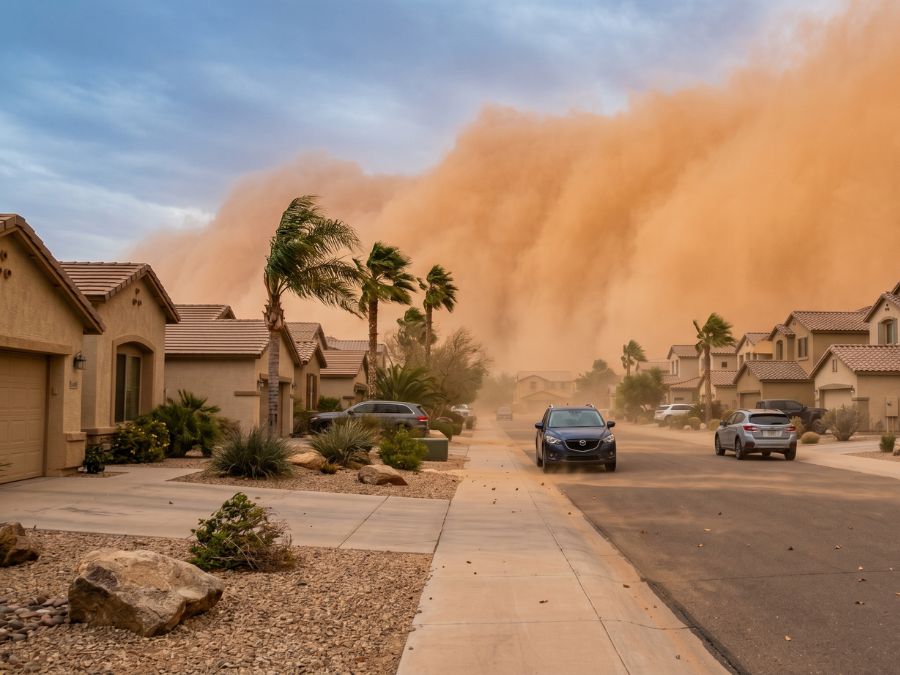
Why Does My Garage Door Grind After a Haboob Dust Storm in Scottsdale?
Quick Answer:
If your garage door grinds after a Scottsdale haboob, it’s caused by fine desert dust acting like mechanical sandpaper inside your tracks, rollers, and bearings. Never apply lubricant to a dirty door—this creates a thick abrasive paste that accelerates wear and motor strain. The correct fix is to clean the system first, clear debris from rollers and moving parts, and then apply a dry silicone or lithium-based lubricant to the hinges and bearings only. If the grinding started after a storm, your door isn’t broken—it’s contaminated.
Why Haboob Dust Is So Hard on Garage Doors
In Scottsdale, haboobs aren’t just messy—they’re mechanical stress tests for anything that moves.
These storms carry extremely fine desert dust that doesn’t just settle on surfaces. It gets forced into tight mechanical spaces under pressure, especially around garage doors where small gaps allow airflow to pull particles inside. Unlike larger debris, this dust is fine enough to infiltrate bearings and hinge joints.
When we’re servicing homes after storms in areas like North Scottsdale, the Airpark, or Troon, we see the same pattern. The door worked perfectly before the storm, and immediately after, it sounds rough, strained, or inconsistent.
A haboob doesn’t just dirty your garage door—it turns it into a grinding machine. And the longer that dust stays inside, the more damage it causes.
What That Grinding Noise Actually Means
A grinding sound is not just noise—it’s friction where there shouldn’t be any. Garage doors are engineered to move smoothly using rollers, hinges, and bearings that reduce resistance. When dust contaminates those parts, it disrupts that balance and creates drag inside the system.
That friction leads to premature roller wear, bearing failure, and increased strain on the opener. Over time, it can even lead to metal-on-metal contact, which accelerates damage significantly.
Left untreated, this type of contamination can destroy key components in weeks, not years. That grinding sound is an early warning, not a minor annoyance.
The Track Contamination Problem
The first place dust shows up is inside the tracks.
During a haboob, high winds combined with pressure differences around the garage opening can pull dust under the bottom seal and directly into the track system. This happens even when the door appears fully closed.
Once inside, the dust settles along the roller path. As the door moves, rollers grind that dust into the metal surface, creating a rough, abrasive channel that worsens with every cycle.
This is where many homeowners make a critical mistake—they reach for lubricant instead of cleaning. That approach doesn’t fix the issue. It locks it in.
The WD-40 Mistake
One of the most common mistakes we see after a haboob is using standard WD-40. While it may seem like a quick fix, standard WD-40 is actually a degreaser, not a long-term lubricant. It strips away existing protective grease from hinges and bearings, leaving components exposed.
Even worse, it creates a slightly sticky surface that attracts dust. In Scottsdale’s heat, that mixture bakes into a thick, black sludge that increases resistance and accelerates wear.
What starts as a temporary fix can lead to a “frozen” or heavily strained door over time. In desert conditions, you need a non-tacky lubricant that repels dust—not something that traps it.
Why Lubrication Can Backfire
Lubrication only works when the system is clean. If you apply lubricant over dust, it mixes with the debris and forms an abrasive paste. Instead of reducing friction, it increases it by forcing particles deeper into moving parts.
This paste doesn’t just sit on the surface—it gets pulled into roller bearings, hinge joints, and pivot points where it’s almost impossible to remove without a full cleaning. Once inside, it continues grinding every time the door moves. This is especially problematic in Scottsdale because the dust is so fine. It doesn’t just coat components—it embeds into lubricated surfaces and turns them into high-friction contact points.
This paste sticks to rollers, hinges, and bearings, making movement more difficult and causing additional wear. It’s one of the fastest ways to turn a minor issue into a major repair. Over time, it can also affect the opener system. As resistance increases, the motor has to work harder, which can lead to overheating, gear wear, or premature opener failure—especially during peak summer heat.
In Scottsdale, the correct sequence is always clean first, then lubricate. Skipping that step doesn’t just delay the fix—it actively accelerates long-term damage.
Why Rollers Take the Most Damage
Rollers are the most exposed and most vulnerable component during a dust storm.
As they travel through contaminated tracks, they pick up dust and carry it directly into their internal bearings. This leads to different types of failure depending on the roller material.
With nylon rollers, the outer surface begins to wear down, sometimes creating flat spots that cause the door to vibrate or jump slightly during operation. With unsealed steel rollers, dust penetrates the ball bearings almost immediately, leading to a high-pitched squeal and rough movement.
Once roller damage begins, it doesn’t reverse. It continues to worsen with every cycle of the door.
The Hidden Bearing and Hinge Issue
The damage doesn’t stop at the rollers.
Dust also works its way into hinge pivot points and torsion system bearings, which are responsible for carrying the door’s weight during operation. These parts rely on smooth movement under load, so even small amounts of contamination can create noticeable resistance.
Because these components are less visible, problems often go unnoticed until the system becomes significantly louder or harder to operate. By that point, wear has already progressed. This is why a grinding sound often feels like it’s coming from multiple areas—it usually is.
The “Sandpaper Effect” Over Time
Every time the door runs with dust inside the system, it creates what we call a sandpaper effect. Instead of smooth motion, components grind against abrasive particles with every cycle. This gradually wears down rollers, hinges, and even the track surface itself.
Over time, this can lead to more serious issues, including damaged rollers, worn tracks, and increased strain on the opener. What started as a simple cleaning issue becomes a full mechanical problem.
This effect also extends to the opener system. Dust settles on the opener rail, and as the trolley moves, it grinds that debris into the drive mechanism.
If you start seeing fine black debris on your garage floor after a storm, that’s a warning sign. That “black snow” is often shaved material from the opener components, which means the system is literally wearing itself down.
The Right Way to Fix It
To properly fix a grinding garage door after a haboob, the goal is to remove contamination completely before restoring movement.
That starts with thoroughly wiping out the tracks to remove all dust and debris. Rollers, hinges, and exposed components should be cleaned or cleared to remove buildup.
Once the system is clean, it should be inspected for worn or damaged parts. Any rollers with flat spots or failing bearings should be replaced.
After that, a proper dry silicone or lithium-based lubricant can be applied to hinges and bearings—not the tracks. This restores smooth movement without attracting additional dust.
Why This Happens So Often in Scottsdale
This issue is much more common in Scottsdale than in other regions because of the environment.
Haboobs bring extremely fine dust combined with high wind pressure, which forces particles into mechanical systems. In areas like the Scottsdale Airpark or Troon canyons, the wind-tunnel effect intensifies this process.
In these zones, we often see dust effectively “sandblast” lubricant off hinges and components during a storm. This leaves metal surfaces dry and exposed, making them even more vulnerable to the next layer of dust.
Unlike humid environments where debris settles, Scottsdale dust remains loose and mobile, allowing it to penetrate deeper into moving systems.
The Reality Check Most Homeowners Run Into
We get a lot of calls from homeowners who say their garage door “suddenly” started grinding after a storm. From their perspective, it feels like a failure that came out of nowhere. The door was quiet one day, and the next it sounds rough, loud, or strained.
In reality, the system didn’t fail—it got contaminated. What changed wasn’t the hardware—it was what got inside it. The haboob introduced fine abrasive dust into parts of the system that rely on smooth, clean movement to function properly.
This isn’t a random issue, and it won’t fix itself. Every time the door runs with dust inside, it increases wear and damage, even if the door still seems to be working. What makes this frustrating is that the damage is gradual but constant. By the time the noise becomes noticeable enough to act on, the system has already been wearing down with each cycle.
In Scottsdale, this is one of the most common causes of early garage door failure, and it’s almost always preventable with proper cleaning and maintenance immediately after a storm.
What a Healthy Door Should Sound Like
A properly functioning garage door should move smoothly and quietly, even in desert conditions.
There should be no grinding, scraping, or vibration. The motion should feel consistent from start to finish, without hesitation or resistance.
If the sound changes after a storm, that’s a clear sign something has entered the system. A healthy door doesn’t suddenly get louder without a cause.
FAQs
Is it safe to use my garage door if it’s grinding?
It may still operate, but continued use can accelerate damage. It’s best to address the issue early.
Can I fix it with WD-40?
No. Standard WD-40 is a degreaser and can make the problem worse by attracting dust and removing protective grease.
Should I clean the tracks myself?
You can remove visible debris, but deeper contamination often requires a more thorough cleaning and inspection.
How soon should I check my door after a haboob?
Ideally within 24 to 48 hours to prevent dust from being worked deeper into the system.
What does “black dust” on the floor mean?
It may be worn material from rollers or the opener system, indicating internal wear caused by contamination.
Why This Matters in Scottsdale
In Scottsdale, your garage door isn’t just dealing with daily use—it’s constantly exposed to extreme environmental conditions.
Haboob dust can turn a smooth system into a high-friction one almost instantly. If it isn’t removed, it continues to degrade components with every cycle.
Addressing the issue early protects the system and extends its lifespan. In this environment, proper maintenance isn’t optional—it’s essential.