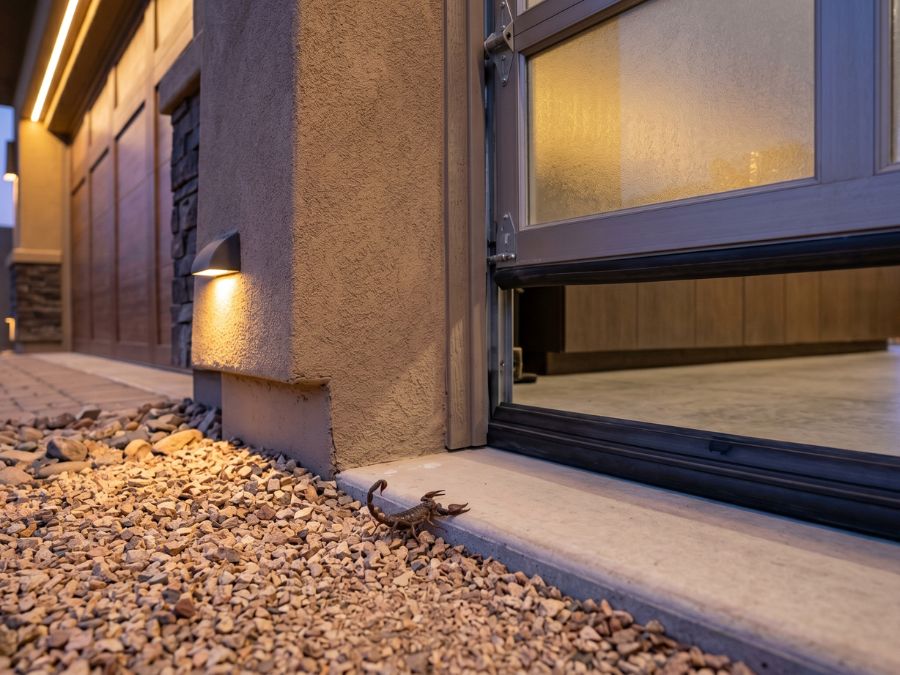
How Do I Stop Scorpions From Getting Under My Garage Door in Scottsdale?
Quick Answer:
To stop scorpions from entering your Scottsdale garage, you must eliminate the “light gap” using a full-perimeter sealing approach. Bark scorpions can flatten their bodies to fit through openings as thin as 1/16 of an inch, roughly the thickness of a credit card. A complete solution requires three things: upgrading to heat-resistant silicone or EPDM seals, sealing the sides and top of the door, and installing a threshold if the concrete is uneven. If you can see sunlight under your door during the day, a scorpion can walk right in at night.
Why Garage Doors Are the #1 Entry Point for Scorpions
In Scottsdale, especially near the McDowell foothills and desert-edge communities, garages are one of the most common entry points for scorpions. This is because the garage sits directly at ground level and connects the outside desert environment to the interior of the home.
When we’re out servicing homes in areas like Troon, DC Ranch, or Desert Mountain, we consistently find that the issue starts at the garage perimeter. The bottom seal, corners, and vertical edges create a direct pathway inside, especially when materials begin to degrade under heat.
Scorpions don’t need much space. A Bark Scorpion can flatten its body and move through an opening no thicker than a credit card, which means even tiny imperfections in the seal become access points.
Once a scorpion gets into the garage, it’s only one gap away from entering the home through shared walls, door thresholds, or utility penetrations.
Why the “Climber” Factor Changes Everything
Most homeowners focus only on the bottom of the garage door, but that approach misses a critical detail.
The Arizona Bark Scorpion is the only species in the Valley that can climb vertical surfaces and even move across ceilings. That means it doesn’t rely on ground-level entry the way other pests do.
If your side weatherstripping has dried out or pulled away from the frame—a common issue in Scottsdale heat—the scorpion can climb the wall, follow the door tracks, and enter through the side gaps or even the top header.
This is why a bottom seal alone is not enough. A proper solution requires a full-perimeter “home seal” approach that eliminates gaps along the bottom, sides, and top of the opening.
The “Light Gap” Test Every Homeowner Should Do
One of the simplest ways to diagnose the problem is also one of the most effective.
Stand inside your garage during the day with the door closed and look along the entire perimeter. If you see daylight anywhere—along the bottom, corners, or sides—you’ve identified an entry point.
In Scottsdale homes, these gaps are rarely uniform. The center may seal tightly while the corners or edges lift slightly due to slab movement or material wear.
From a pest-control perspective, even the smallest visible gap is enough. If light gets through, something else can too.
Why Standard Seals Fail in Scottsdale Heat
Most homes come with basic vinyl weatherstripping, and that material simply isn’t designed for Scottsdale conditions.
Garage floors and door frames can reach extreme surface temperatures during the summer, especially in direct sunlight. That heat causes vinyl to dry out, lose flexibility, and eventually crack or curl.
In many cases, seals begin to fail within just a few seasons. Once they lose their shape, they no longer maintain contact with the floor or frame, creating consistent gaps.
This is why replacing a seal with the same material often leads to the same issue again. The environment demands a higher-performance solution.
EPDM vs. Silicone: What Actually Works
Choosing the right material is what determines whether the fix lasts or fails.
EPDM rubber, which stands for Ethylene Propylene Diene Monomer, is the industry standard for heat resistance. It performs well in high temperatures and is a major upgrade over vinyl.
However, in higher-end Scottsdale homes, we often prefer silicone-blend seals. The key advantage is compression memory. Silicone maintains its shape and pressure over time, meaning it doesn’t “flatten out” as quickly under constant contact with the floor.
That difference matters because once a seal loses its compression, gaps begin to form again. A silicone-based system maintains a tighter, more consistent seal for longer, especially in extreme heat cycles.
The Uneven Concrete and Slab Heave Problem
In Scottsdale, garage floors are rarely perfectly level, and this becomes more noticeable over time.
In newer developments, we often see slab heave caused by expansive desert soil. This can create dips or uneven sections in the concrete, sometimes as much as half an inch across the width of the garage.
A standard three-inch seal simply can’t bridge that kind of variation. It will make contact in some areas and leave gaps in others.
To solve this, we often use oversized six-inch U-shaped seals that can compress deeper and adapt to the surface. This allows the door to maintain a consistent barrier even when the floor isn’t perfectly flat.
When You Need a Garage Threshold
In some cases, even an upgraded seal isn’t enough.
If the floor has significant variation, installing a garage threshold becomes the most effective solution. This is a fixed rubber barrier attached to the concrete that creates a consistent sealing surface.
When the door closes, the bottom seal compresses against the threshold instead of trying to follow the uneven slab. This eliminates gaps across the entire opening and creates a more reliable long-term barrier.
In Scottsdale homes, this is one of the most effective ways to stop both scorpions and dust infiltration.
The Weep Screed Connection Most People Miss
One overlooked entry path starts outside the garage entirely.
Scorpions often travel along the weep screed, which is the small gap at the bottom of your home’s stucco designed for moisture drainage. This path leads directly to the base of the garage door frame.
If the side weatherstripping is not tight against the stucco, that pathway becomes a direct entry point. In effect, the scorpion follows the wall straight into the garage opening.
We see this frequently in Scottsdale homes where side seals have dried out or pulled away from the structure. Sealing that vertical connection is just as important as addressing the bottom of the door.
Why Alignment Matters More Than You Think
A high-quality seal won’t perform properly if the door itself is misaligned.
Garage doors need to close evenly across the entire opening. If one side makes contact before the other, or if the door is slightly tilted, gaps will form regardless of the material being used.
In Scottsdale, thermal expansion can make this worse. As temperatures rise, metal components shift slightly, which affects how the door sits against the floor.
That’s why a proper fix often includes adjusting the door system, not just replacing the seal. The mechanics and materials have to work together.
The Reality Check Most Homeowners Run Into
We get a lot of calls from homeowners who have already replaced their seal and are still seeing scorpions.
In most cases, the problem wasn’t the idea—it was the approach. The seal material wasn’t suited for the environment, the door wasn’t aligned correctly, or the side gaps were never addressed.
In Scottsdale, quick fixes don’t hold up. The conditions are too extreme, and the tolerances are too tight.
If there’s a gap anywhere in the system, something will find it.
What a Properly Sealed Garage Looks Like
When everything is done correctly, the difference is immediate and visible.
The door sits flush against the floor with no visible light along the bottom. The corners are sealed, the side weatherstripping is tight against the frame, and there are no weak points along the perimeter.
From the outside, it looks like a standard garage door. But from a performance standpoint, it’s fully sealed against both pests and environmental intrusion.
FAQs
Can scorpions really climb into my garage?
Yes. Arizona Bark Scorpions can climb vertical surfaces and even move across ceilings, which means they can enter through side gaps and not just the bottom of the door.
What is the best seal material for Scottsdale homes?
EPDM is excellent for heat resistance, but silicone-based seals perform better long-term because they maintain compression and don’t flatten as quickly.
Do I need to seal the sides of the garage door too?
Yes. Side gaps are a common entry point, especially when weatherstripping dries out or pulls away from the frame.
What is slab heave and why does it matter?
Slab heave is movement in the concrete caused by soil expansion. It creates uneven surfaces that standard seals can’t fully close.
Will a threshold stop scorpions completely?
A threshold significantly reduces entry points, especially when combined with proper sealing and alignment, but it must be part of a full-perimeter solution.
Why This Matters in Scottsdale
In Scottsdale, pest control isn’t just about treatment—it’s about eliminating entry points at the structural level.
Your garage door is one of the largest openings in your home. If it isn’t sealed correctly, it becomes a direct pathway for scorpions and other pests.
Solving the problem properly means addressing materials, alignment, and perimeter sealing together. That’s what turns a temporary fix into a long-term solution.