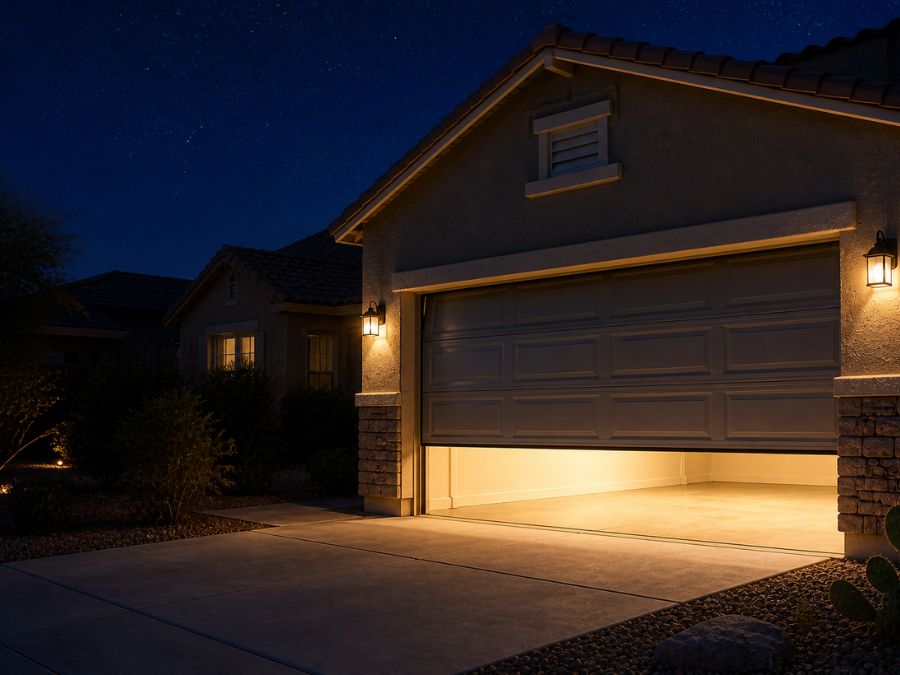
Why Does My Chandler Garage Door Open by Itself at Night?
If your garage door opens by itself at night, the cause is usually tied to a remote, wall button, smart device, wiring issue, or opener control. Start by checking the devices that can send an open command. If it happens again, the opener controls and connected devices should be checked more closely.
Start With What the Door Is Doing
A garage door that opens by itself is usually dealing with a control problem, not a lifting problem. The first step is figuring out whether something sent the opener a command or whether the opener controls are acting incorrectly.
| What You Notice | What It May Mean | What to Check |
| Door opens after a remote was used | Remote problem | Check for a stuck button |
| Door opens with no remote use | Wall control, wiring, or opener issue | Test the wall button |
| Problem started after adding a device | Programming issue | Review connected devices |
| Opener is connected to an app | Smart control may be involved | Check activity history |
| Older opener behaves unpredictably | Older controls may be failing | Check opener age and condition |
For example, if the door opens smoothly at 2 a.m. and the motor sounds normal, the door itself may be working correctly. That makes the remote, wall control, smart device, or opener controls more important places to check.
Check Every Remote
The wall control inside the garage can also send an unwanted command. Press the button a few times and make sure it releases normally. If it feels sticky, loose, or damaged, it may be part of the problem.
Also look at the visible wire between the wall control and opener. A cut, loose, crushed, or pinched wire may affect the control signal. For example, a storage shelf or tight staple can damage the wire without making the problem easy to see.
Do not take apart electrical parts if you are not comfortable doing so.
Check Apps, Keypads, and Car Controls
Many garage door openers are connected to more than one device. Your system may use a keypad, vehicle control, phone app, or smart-home system, and any of these can send an open command.
Review the devices that can open the door and remove old or unknown connections if the system allows it. If your garage door app shows activity history, check what happened around the time the door opened.
If the app shows a normal open command, focus on the device or account that sent it. If there is no matching activity, the wall control, wiring, or opener electronics may deserve more attention.
Could the Opener Be the Problem?
Yes. If the remotes, wall button, and connected devices look normal, the problem may be inside the opener.
The opener has internal controls that receive and process commands. If one of those parts starts to fail, the system may behave unpredictably. An older opener may also show other signs, such as slow response, lost programming, unusual light behavior, or controls that work only sometimes.
One unexplained opening does not automatically mean the opener needs replacement. Check the simpler control sources first.
Does Chandler Heat Play a Role?
Chandler heat can put extra stress on wiring and electronic parts inside a garage, but heat alone should not make a fully closed garage door open.
If the problem seems to happen after very hot days, note the timing. For example, if the opener acts strangely only after the garage has been hot for several hours but works normally earlier in the day, that may be useful during an inspection.
Heat may make an existing electrical weakness easier to notice, but it should be treated as a supporting clue rather than the main cause.
Could the Safety Sensors Cause It?
Usually not if the door was fully closed before it opened.
Safety sensors mainly affect the door while it is closing. If something blocks the sensor beam, the door may stop or reverse upward. That can look like the door opened by itself, but it is a different problem.
If the door had been fully closed and later opened without a command, check the controls, connected devices, wiring, and opener electronics first.
What Should You Notice If It Happens Again?
If the door opens again, pay attention to what happens just before and during the opening. Note whether the opener light comes on, whether the motor starts normally, whether the door opens smoothly, and whether anyone used a remote, app, keypad, or car control.
A smooth opening with a normal motor sound may point toward an unwanted command. A door that also shakes, reverses, or struggles may have a separate mechanical issue.
When the Problem Keeps Coming Back
One unexplained opening may come from an accidental command or temporary control issue. If the door opens by itself more than once, the control side of the system should be checked because the garage may remain open until someone notices.
The most useful next step is to narrow the problem to the remote, wall control, connected device, wiring, or opener electronics instead of replacing parts without a clear diagnosis.
What Gecko Garage Doors Can Check
For an unexplained opening, the useful checks are the remotes, wall control, programmed devices, visible wiring, smart controls, and opener electronics. The door should also be watched during operation to rule out a separate movement problem.
Gecko Garage Doors has served the Phoenix Valley since 1994 and is a licensed, bonded, and insured Arizona contractor, ROC #121561. The company is also a LiftMaster Authorized Dealer.
Need Help With a Garage Door That Opens by Itself in Chandler?
If your garage door keeps opening at night without a clear reason, Gecko Garage Doors can check the opener controls, connected devices, wiring, and door operation to help identify the cause.
The goal is to determine what is triggering the opening before deciding whether a repair or opener replacement is needed.